
A Bigger Nozzle Is Not 'Low Quality'
Posted by SFL Designs on Nov 17th 2026

Somewhere along the way, “bigger nozzle” picked up a reputation as the low-quality option, the thing you use when you do not care how a part looks. That reputation is backwards for a big share of the parts on your printer right now. A bigger nozzle is not a worse nozzle. It is a different tool: fewer, fatter lines of plastic, laid down faster. For functional parts (brackets, mounts, jigs, the stuff SFL prints all day), that is often exactly the tool the job wanted.
What nozzle size actually changes
The nozzle is the little brass (or steel) tip the plastic squeezes out of, and its hole diameter sets the scale of everything downstream. Three things follow from it:
- Line width. A wider nozzle lays a wider bead of plastic. As a rough rule, your extrusion width lands somewhere around the nozzle size and a bit above it.
- Layer height range. Taller layers need enough plastic behind them. A bigger nozzle can push taller layers comfortably; a small nozzle trying to print very tall layers is asking its melt zone to perform miracles.
- Flow. Wider and taller means more plastic per second (volumetric flow, if you want the jargon). Your hotend has to actually melt it all, which is the real speed limit on any printer.
Change the nozzle and you have not changed the printer’s accuracy. You have changed the size of the brush it paints with.
Why fat lines finish sooner, and often stronger
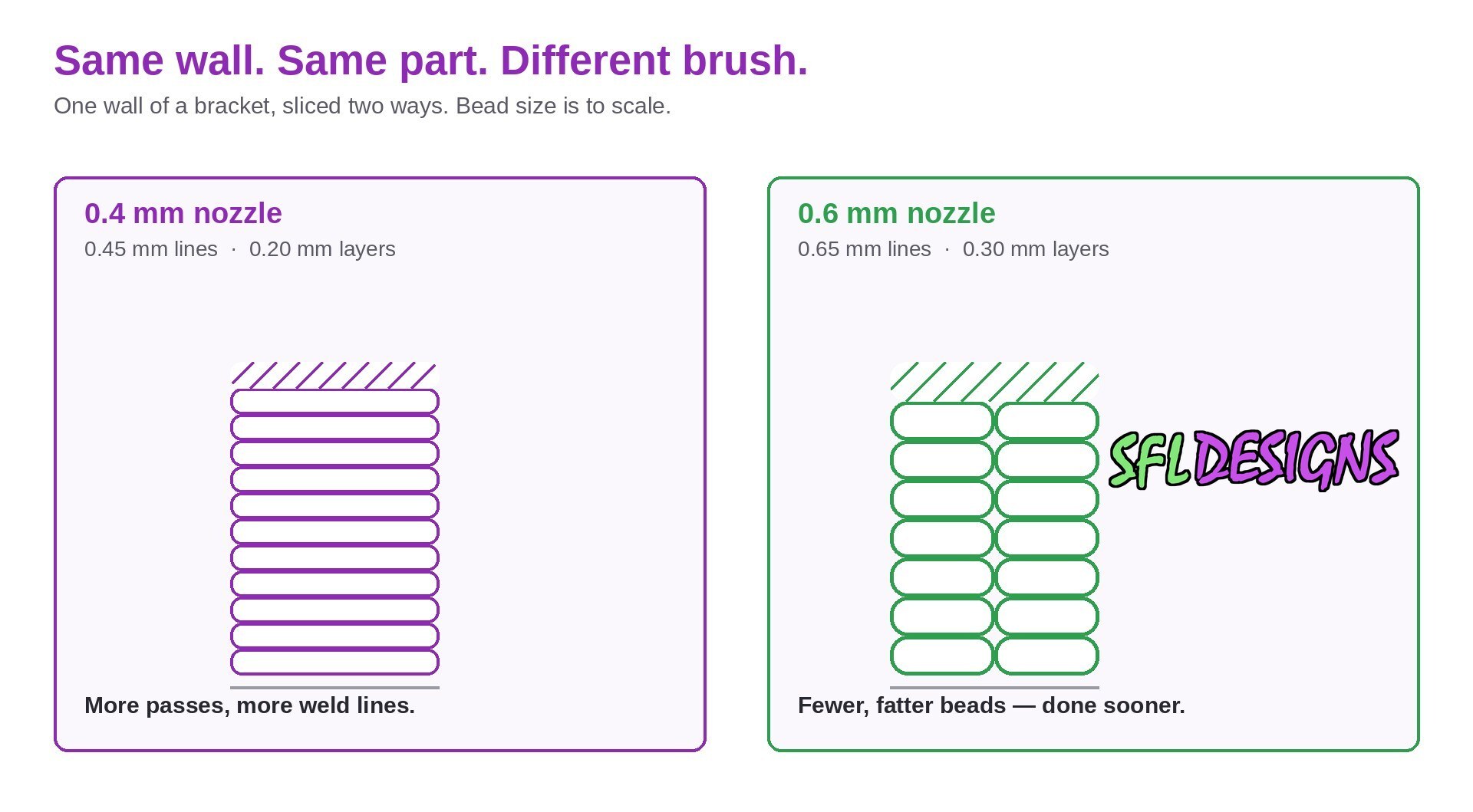
Print time is mostly the printer retracing the same shape at finer and finer scales. A wall that takes four passes with a small nozzle might take two with a bigger one, and taller layers cut the total number of trips up the part. The savings on a chunky functional part are not subtle.
Strength surprises people more. A functional part is only as strong as the welds between its lines of plastic, and fewer, fatter extrusions mean fewer weld lines crossing the part, with each bead carrying more material and staying hot a little longer as it lands. For brackets and mounts that live their lives being pulled on, that is a genuinely good trade. The part gives up surface finesse it never needed and gains time and toughness it uses every day.
What you actually give up
Honesty section. A bigger nozzle is the wrong tool when the part is the detail:
- tiny text and small logos get soft or disappear;
- fine features smaller than the line width cannot exist at all;
- sharp small corners come out rounder;
- thin walls stop being a clean multiple of the line width;
- very small parts turn into blobs with good intentions.
Miniatures, detailed display pieces, fine lettering: keep those on the small nozzle. Nobody is impressed by a fast print of a part whose details moved out.
Good candidates, bad candidates
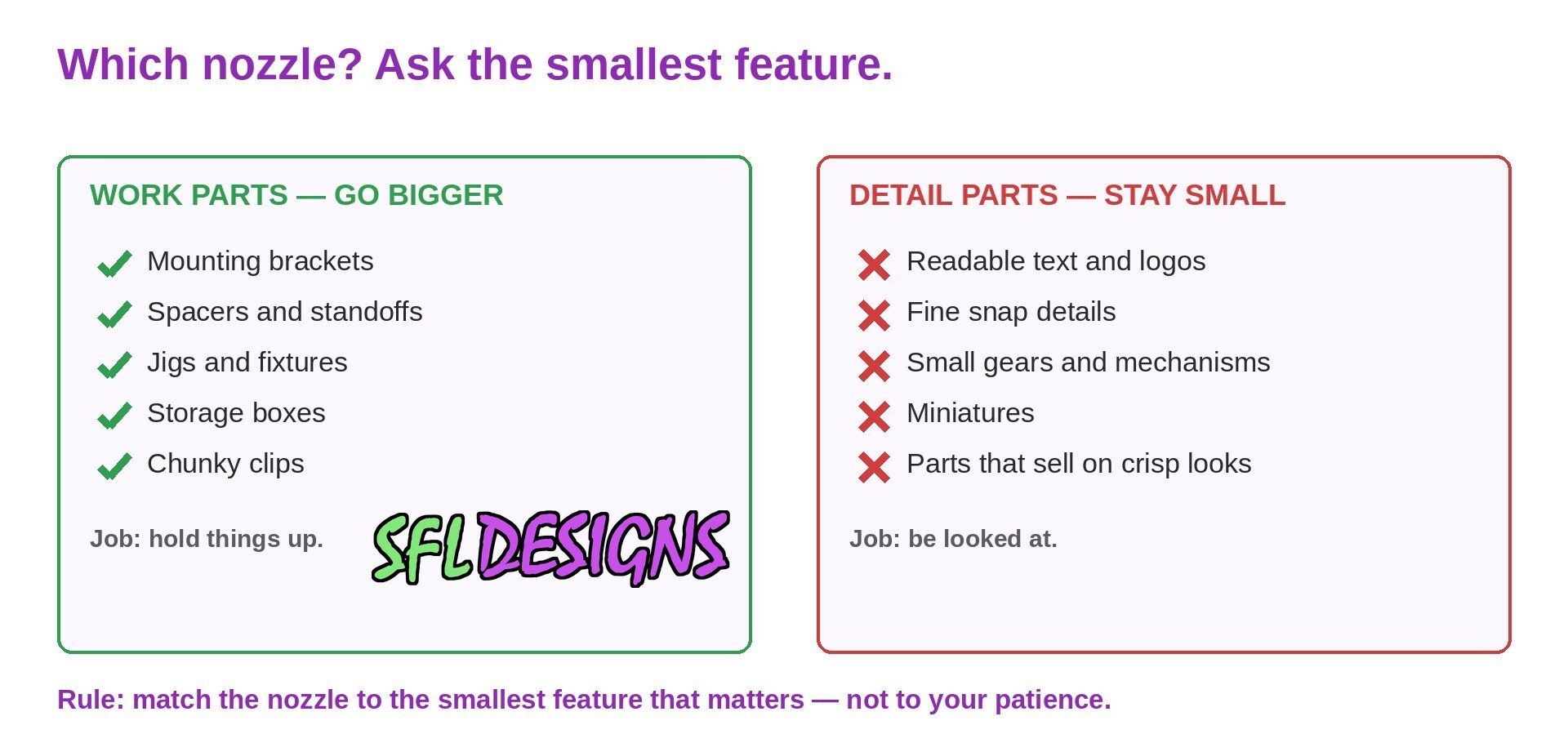
Good candidates for a bigger nozzle: mounting brackets, spacers, jigs and fixtures, storage boxes, clips with generous features, and basically any part whose smallest feature is comfortably larger than the new line width. Bad candidates: anything with text you need to read, snap details at the edge of the line width, gears and fine mechanisms at small scale, and parts that sell on how crisp they look.
Shop note: Match the nozzle to the smallest feature that matters, not to your patience. If the smallest real feature is chunky, the small nozzle is not adding quality. It is adding hours.
If you swap, change the settings too
A nozzle swap without a settings swap is how people conclude the nozzle was bad. At minimum: set the nozzle size in the slicer (it sounds obvious; people forget), raise line widths to suit the new nozzle, pick layer heights inside its comfortable range, and expect to nudge temperature up a little. Melting more plastic per second takes more heat in reserve. Then slice something familiar and read the preview before printing, especially the thin features.
The decision rule
Ask two questions. What is the smallest feature on this part that has to survive? And is this part’s job looks, or work? If the smallest feature is well above the bigger line width and the part earns its keep by holding something up, the bigger nozzle is probably the right call. If the feature list reads like a jewelry catalog, stay small.
Your 0.4 earned its place as the default. It just never earned the right to be the only answer.
— Jason, SFL Designs
From our workbench to your display — print it, mount it, light it up.