
Extensions, Wire Gauge, and How Far Data Will Travel
Posted by SFL Designs on Nov 21st 2026
Last Saturday we met the controllers and their outposts, the receivers. This morning the subject is the least glamorous cable in the yard: the extension, the plain run of wire between the box and the prop. It gets no applause. It also decides whether the applause happens.
Every show is a geography problem. The controller lives where the power is handy and the weather protection is good. The props live where the audience can see them. The distance between those two decisions is extension cable, and it does two jobs at once that fail in two completely different ways.
One cable, two jobs
An extension in a pixel show is usually a three-wire cable. Two wires carry power: the positive and the negative, the same 12V your pixels eat. The third wire carries data, the stream of instructions that tells each pixel what color to be and exactly when to be it.
Power fails slowly and politely. Voltage fades a little with every foot of wire, and the far end of a long run dims and turns pink at full white. We spent a whole morning on that on November 7, and injection was the fix. Data fails rudely. The signal gets fuzzy around the edges, and a prop flickers, freezes, or flashes colors nobody programmed. Same cable, two failure modes, two different repairs. Learning to tell them apart is half of troubleshooting, and it starts right here.
Wire gauge: the number runs backwards
Wire thickness is measured in gauge, written AWG (American Wire Gauge), and the scale runs the way nobody expects: the smaller the number, the thicker the wire. A 14 AWG wire is fat. A 20 AWG wire is skinny. Wire makers have had two centuries to fix this and have declined.
Thicker wire fights voltage drop. Picture water in a hose: a skinny hose feeding a long run dribbles at the far end, because the hose fights the flow the whole way. A fat hose still has pressure left when it arrives. Wire is the same story: every foot eats a little voltage, and skinny wire eats more per foot.
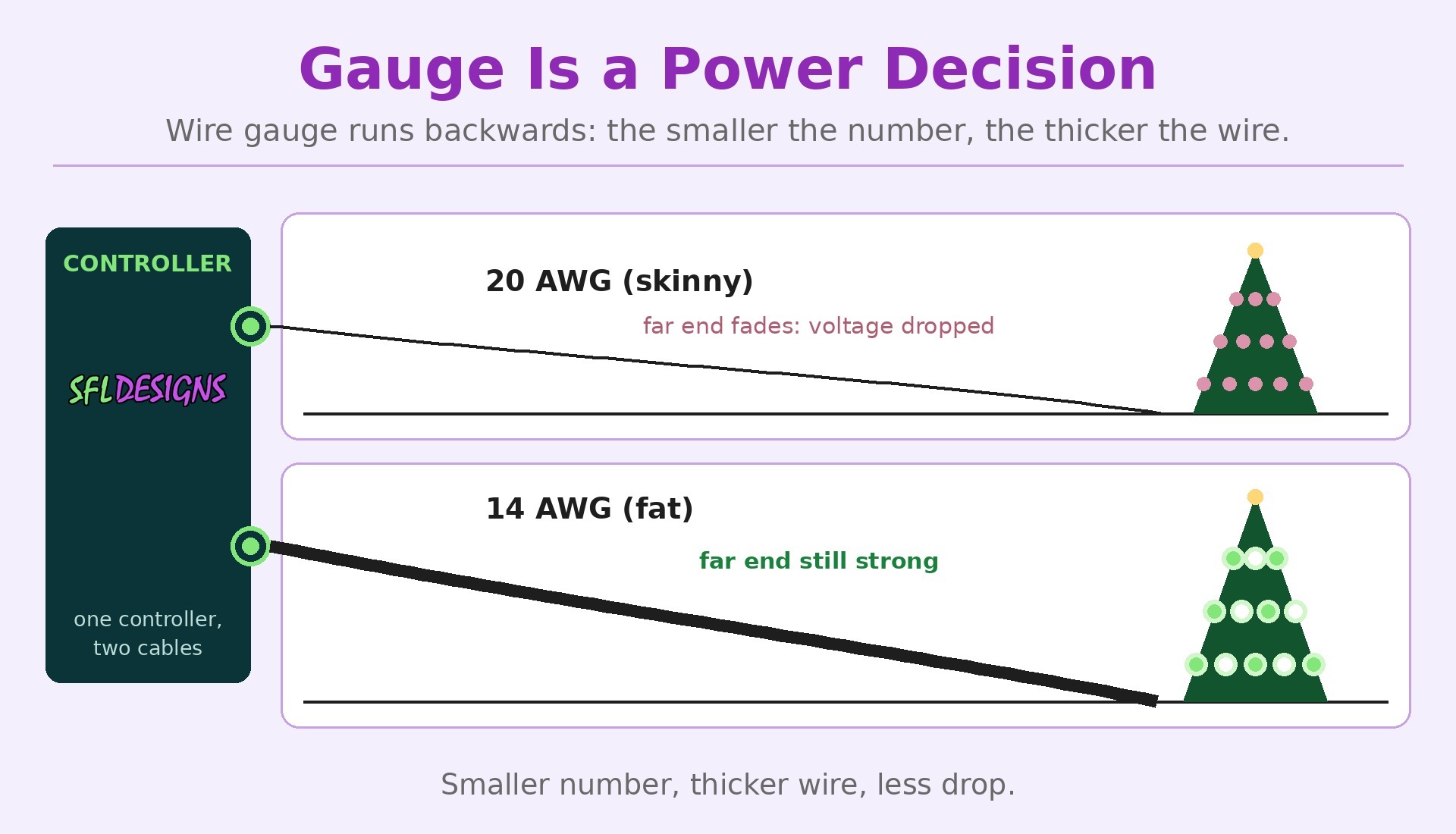
That is why gauge is a power decision, not a price decision. The two questions are: how much current is this run feeding, and how far is it going? A short hop to one small prop forgives thin wire. A long run feeding a hungry prop does not. Most ready-made pixel extensions are built on 18 AWG wire, which covers a lot of honest yard work. The long runs and the heavy loads are where you step up to thicker wire and stop asking a skinny cable to do a fat cable's job.
Bigger is not always better, though, especially with data. The data signal does not get stronger just because the wire around it got fatter. Oversized cable is stiffer, heavier, and harder on the connectors at both ends. Size the wire for the power the run carries and the distance it covers, and no bigger than the job asks.
How far will data travel?
The data signal has one big thing going for it: every pixel catches it, cleans it up, and hands it on fresh to the next pixel. That rescue service is why a string of three hundred pixels works at all. The weak leg of any run is the stretch with no pixel in it: from the controller to the first pixel of a prop, or from the last pixel of one prop to the first pixel of the next.
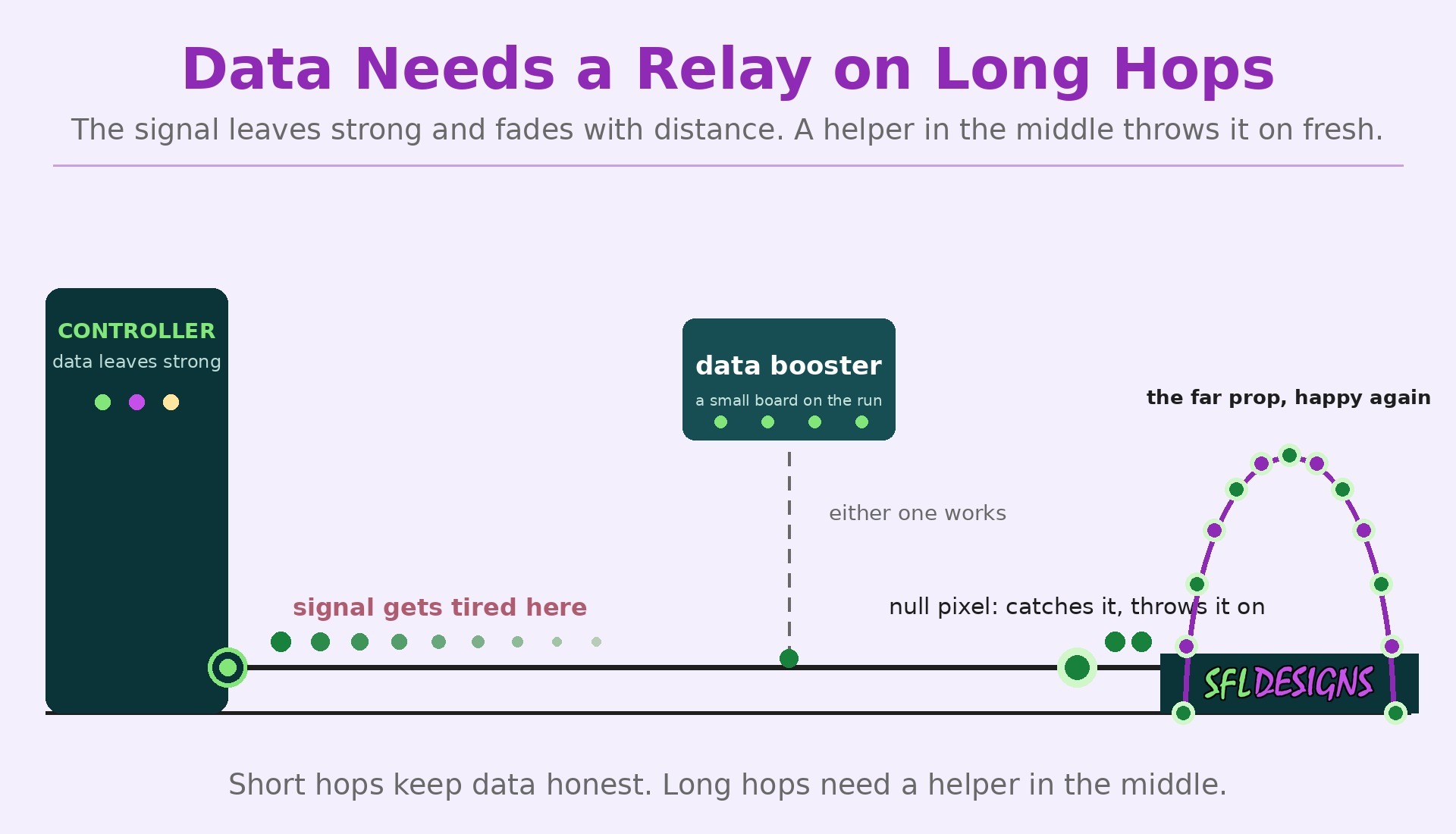
Those empty stretches are where data gets tired. Keep them modest and everything behaves. The hobby's rule of thumb is to keep a bare data hop to the tens of feet, and to get suspicious of any hop that grows well past that with nobody in the middle to help it along.
Full honesty: I have run a bare hop of about 50 feet and gotten away with it. That is not the goal, though. The goal is to keep the controller or the receiver as close to the first pixel as you can, so the hop never gets the chance to misbehave.
When a long hop is unavoidable, you have three honest options. Move a receiver closer to the prop, the way we talked about last Saturday: short data hops are the whole reason receivers exist. Add a data booster, a small board that takes the tired signal in one side and re-sends it strong out the other. Or plant a null pixel, a single pixel wired into the middle of the hop that lights nothing anyone watches and simply catches the signal and throws it onward, usually wrapped in tape and forgotten on purpose. All three beat the fourth option, which is hoping, and hope is not a wiring method.
Ready-made or roll your own
Ready-made extensions cost more per foot and earn it: matched waterproof connectors on both ends, a known gauge, and zero soldering. When one dies in December, you swap it and the show goes on.
Roll your own from bulk cable and pigtails (the short connector tails you splice onto your own wire) and you get any length you want for less money per foot. You also become the quality department. Every splice is yours, and a weak one will introduce itself in the rain, at ladder height, on the coldest night of the year.
Most yards end up mixed: ready-made for the long standard runs, homemade for the odd lengths nothing on a shelf fits. There is no prize for purity here. There is only a show that works on a wet Friday night.
Shop note: Label both ends of every extension with its length and where it goes. Painter's tape and a marker are fine. A coiled 20-foot extension and a coiled 25-foot extension are identical twins in the dark, and the difference between a five-minute hookup and a tape measure at 9 pm is a label you wrote in October.
Before you coil them up
So the rules of the road: pick gauge for the power the run carries, keep bare data hops short or give them help, and test every extension before it goes in the tote. Get the signal there clean and everything downstream gets easier. Which is good, because this afternoon we finally put that signal to work: the six effects that do ninety percent of the show, riding in on these very wires.
— Jason, SFL Designs
From our workbench to your display — print it, mount it, light it up.