
Power Injection: The Fix for Pink Lights
Posted by SFL Designs on Nov 7th 2026
Last Saturday morning we sized the power supply, and the math said the show had plenty. So why does the roofline start white at the box and end up pink at the far corner?
Nothing is broken. Nothing is dying. That pink tail is voltage drop, and its fix has a great name: power injection. This morning we take the pink out.
The symptom: white that will not stay white
White is the most demanding thing you can ask of a pixel: it is really three lights (red, green, and blue) all running at full at once. Feed the run less than full voltage and white is the first color to confess.
The confession looks like this: pixels near the supply look right, and down the run the white slides toward pink or salmon, worse the farther you go. You saw a preview last Saturday afternoon: the bars test runs at full white, and a weak run tattles on itself right there.
Why it happens: voltage drop, in plain words
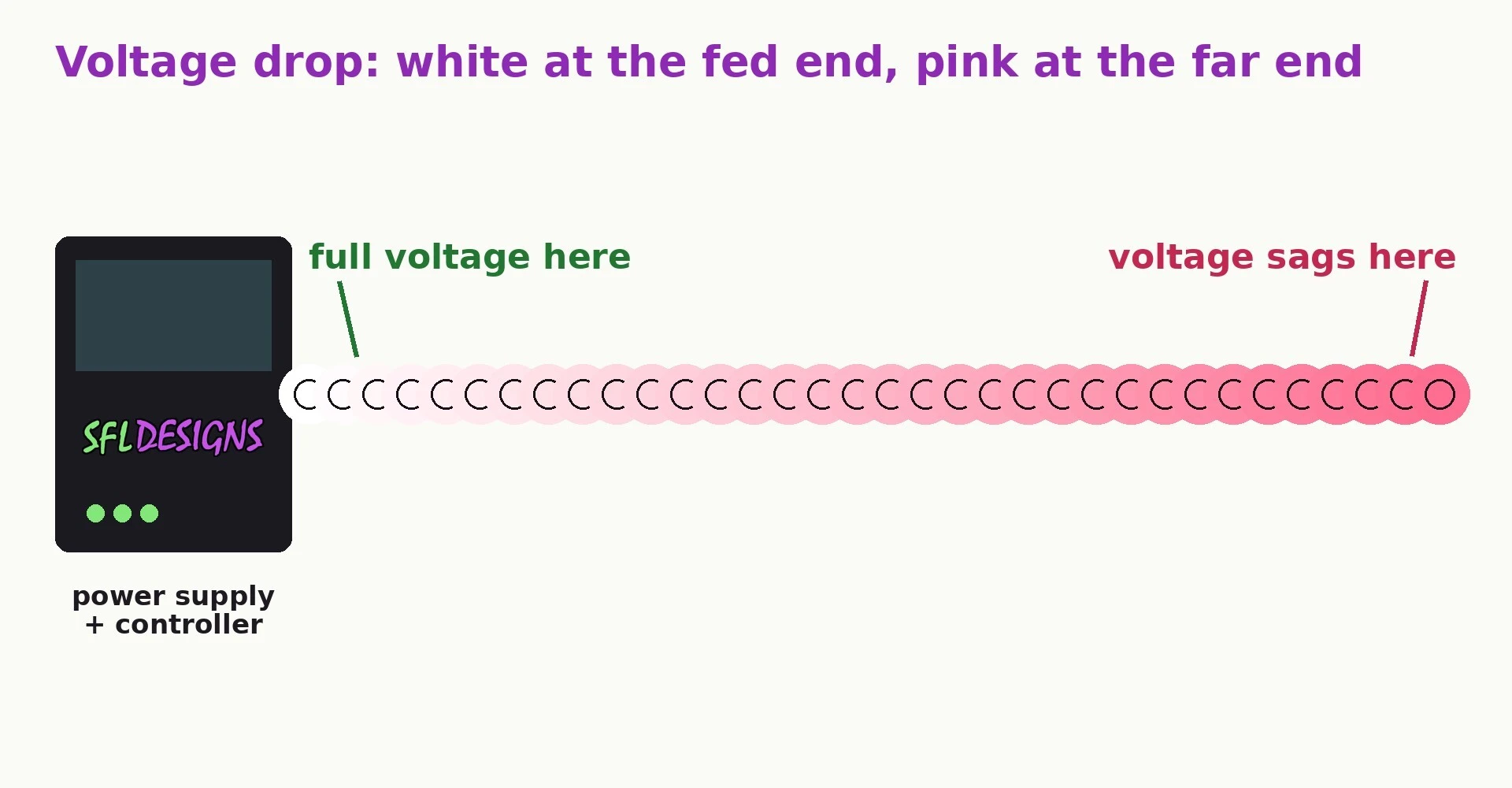
Voltage is push: the pressure that shoves electricity down the wire. Wire is not a perfect pipe, though. Every foot of wire pushes back a little, and every pixel takes its sip and passes the rest along. By the far end of a long run, the push has faded. That fade is voltage drop. Every run has some; long, hungry runs have more.
Picture a garden hose with sprinklers tapped in along it. The first sprinkler dances. The last one sighs. Same hose, same water, less pressure at the end.
Now the color part. The three lights inside a pixel do not need the same push. Red gets by on the least. Blue needs the most. As voltage sags, blue gives up first, green fades next, and red, the stubborn one, hangs on longest. Red plus a little green minus most of the blue equals pink. Your far pixels are not broken; they are underfed, and pink is the color of underfed.
One more reason the house standard is 12V: the same sag is a smaller bite out of 12 volts than out of 5, so a 12V run travels farther before it blushes. Our 5V friends run beautiful shows. They just get to practice injection sooner, and we tease them with love.
The fix: feed the run more than once
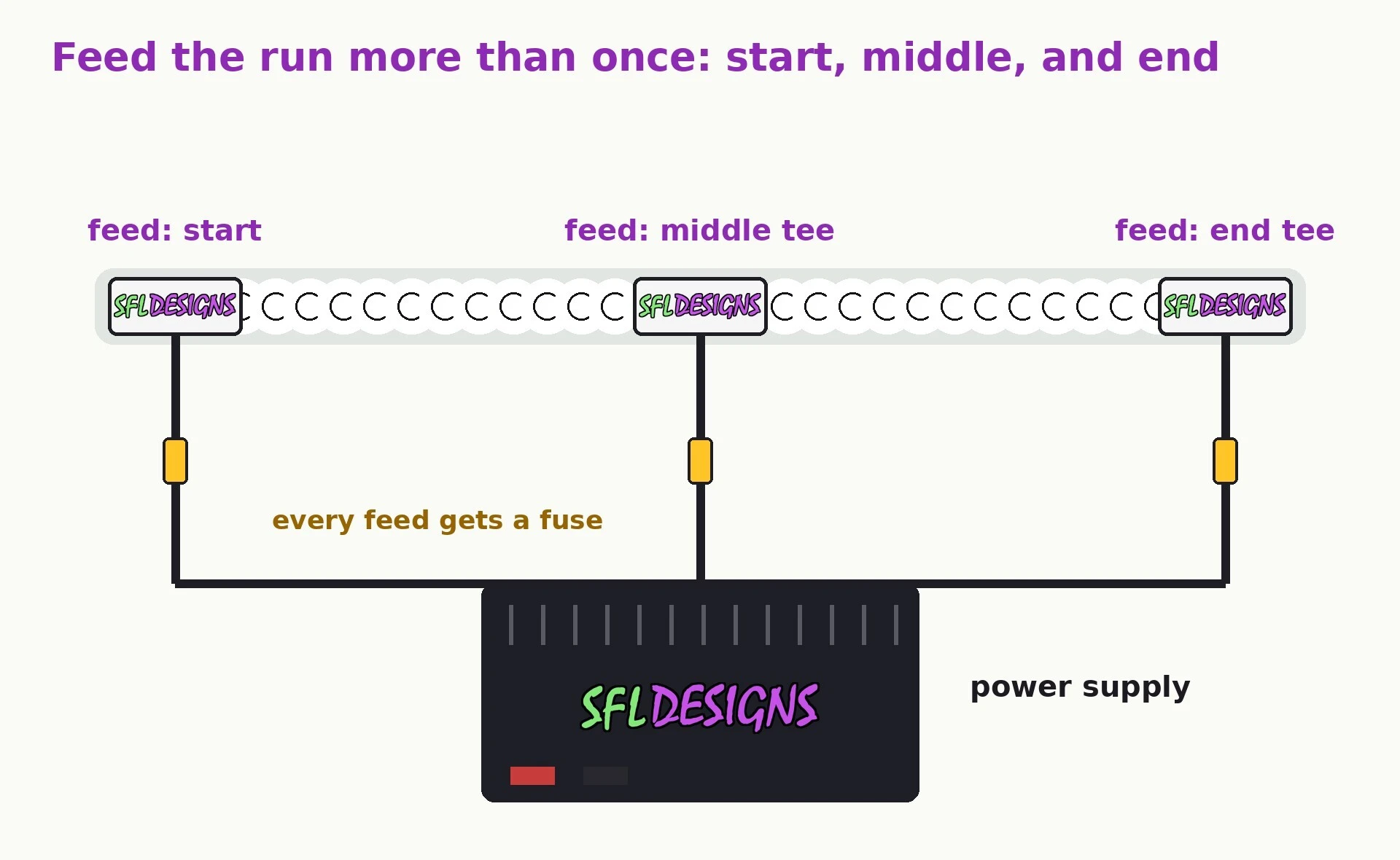
Power injection means feeding a run at more than one point. Instead of all the power entering at the start and limping to the end, fresh power taps in along the way, through connectors called tees. A tee splices into the string so power wires can join mid-run while the data (the instructions for each pixel) keeps traveling through the pixels as always. You are not adding data. You are adding push.
The extra feed can be a branch off the same supply feeding the start of the run. It can also be a second supply brought in partway down the run, which is common on big props and long rooflines. Second supplies come with one non-optional rule: tie the commons together. The common is the negative side of the supply. When two supplies feed one run, their negative sides must be connected, so the whole run shares one ground and the data keeps a steady reference. Skip it and you get flicker and strange behavior that eats an evening.
Every feed, start or injected, gets a fuse: a cheap part that sacrifices itself if a short tries to pull too much current, turning a wiring mistake into a two-dollar lesson instead of a melted one.
Where the feeds go
Start with the easy win: feed both ends. The middle pixels now draw from whichever end is closer, and the worst sag disappears.
For long runs, add a feed in the middle too. A common rule of thumb is a fresh feed somewhere around every hundred pixels on a 12V bullet run, sooner on strip, which is hungrier per foot. Treat it as a planning habit, not a law. Your real test is the eyeball test: run the string at full white and look. Where the color starts to slide, a feed belongs just before that spot.
Plan it on the bench: on a long run, build the tees in while the string is on the table. November-you, on a ladder in the wind, sends thanks.
Shop note: Tag every injection lead at both ends with what it feeds and where it lands. In November, in the dark, in gloves, every black wire looks like every other black wire. A ten-cent label written on the bench is the difference between a two-minute hookup and a guessing game with a multimeter.
The cousin trick: power balancing
There is a related trick from the seed pixel world: power balancing. Balancing wires the prop with an extra wire that taps the positive and negative right at the start of the run and carries power straight to the far end, so the last pixels get fed directly instead of waiting on the trickle. Same goal as injection (hold the voltage up all the way down the run), different plumbing. Injection adds feeds along the run; balancing gives the far end its own straight shot. They are not rivals, and around here we use both.
Two ways to make pink worse
Cranking the brightness up feels like the fix and does the opposite: more brightness means more current, more current means more drop, and the far end slides further into pink.
And the second: feeding a run from two supplies without tying the commons. Weird flicker, random behavior, an evening gone. Tie the commons. Every time.
Tonight the whole house learns to move as one: groups, the cheat code behind whole-house effects. The runs are fed. Time to teach them to dance together.
— Jason, SFL Designs
From our workbench to your display — print it, mount it, light it up.