
Buy the Mean Well, Size It Like You Mean It
Posted by SFL Designs on Oct 31st 2026

Two Saturdays ago we mapped the whole show. Last Saturday we picked the pixels and told the controller where they live. This morning we feed them, and we start with the least glamorous box in the yard: the power supply.
Nobody has ever stood in your driveway and said, "Beautiful power supply." But every show you have ever admired ran on one that was sized right and bought once. The supply is where shows quietly live or die, so let us size it like we mean it.
What the numbers on the box mean
A power supply takes the wall outlet's power and hands your show a steady 12 volts (our house standard around here). Two numbers on the label matter.
Watts are the total work the supply can do, all of it added together. Amps are how much current it can hand out at that voltage. They are the same story told two ways: watts = volts × amps. So a supply rated at 350 watts on the 12 volt side can hand out about 29 amps (350 ÷ 12). When you shop, the watt number is the headline; when you plan, the amp number is the one you will actually spend.
What one pixel costs
Every pixel on your strings is a tiny spender. At full white, full bright, one 12 volt pixel draws about 0.06 amps. That is the planning number, and we plan with the worst case on purpose: the moment in your show when everything goes white at once is exactly the moment you cannot afford a surprise.
Your show will spend most of its life well under that number, because most effects are colors, not full white, and most shows run at less than full brightness. Good. Headroom you never touch is not waste. It is the margin that keeps a cold December night boring, and boring is the goal.
Add up one prop, then the whole house
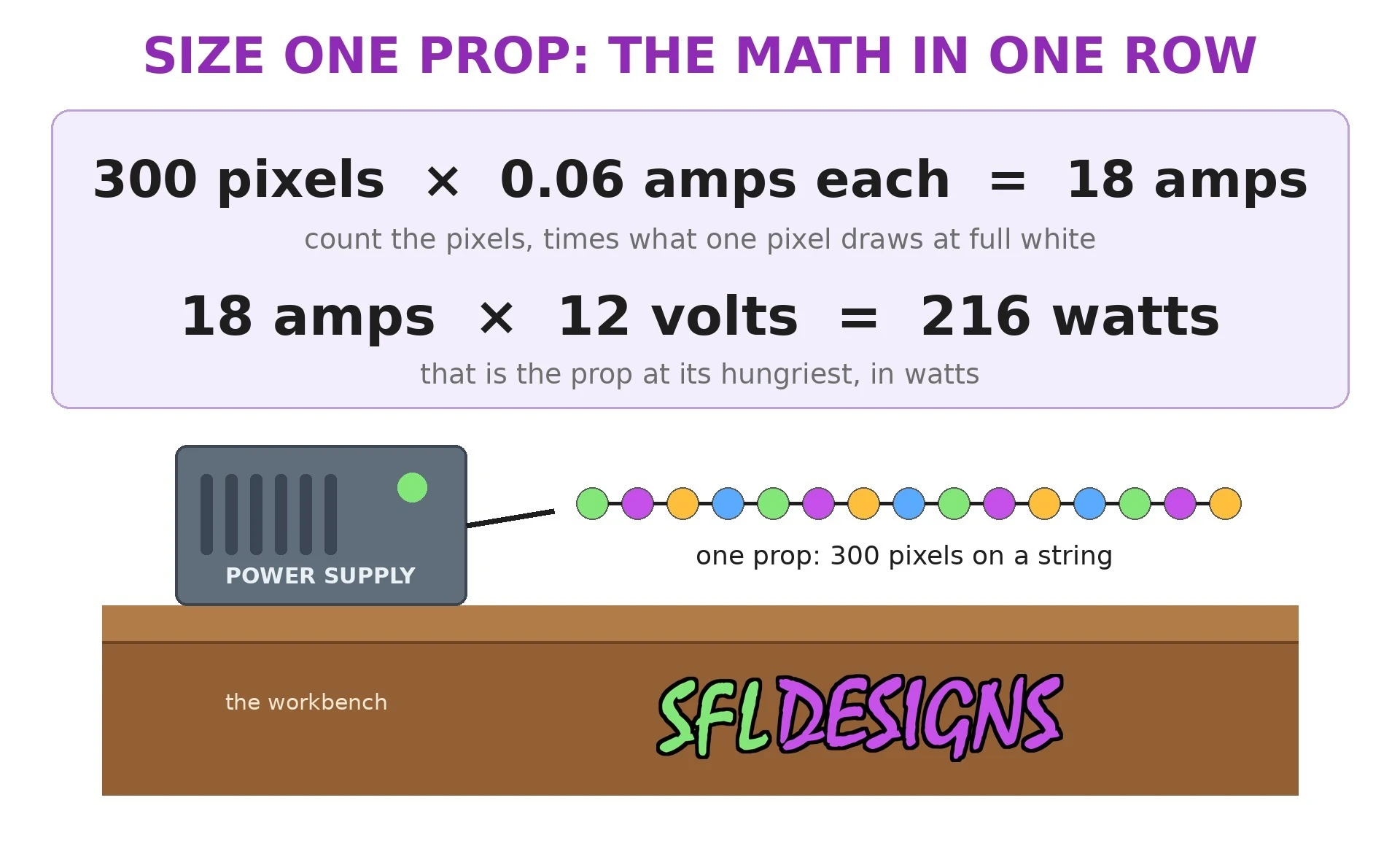
The math is friendly, and it goes prop by prop. Say a prop has 300 pixels.
- 300 pixels × 0.06 amps = 18 amps
- 18 amps × 12 volts = 216 watts
That is the prop at its hungriest. Now do the same for every prop that will share a supply, and add the watts together. Most shows end up with a supply per controller box, or per zone of the yard, rather than one giant supply feeding everything from the garage. Shorter runs, saner cable, and when something does go wrong at 9 p.m., one dark zone beats a dark house.
Write the total on your show map from two weeks ago, next to each zone. Shopping from a written number is how you buy a supply once.
Shop note: When a supply goes in a box, take ten seconds and write its watt budget on the lid with a paint pen: "This box: 280 watts max, 216 planned." Next October, when you are adding one more prop and wondering if there is room, the lid answers the question before your memory starts guessing.
The 80 percent rule
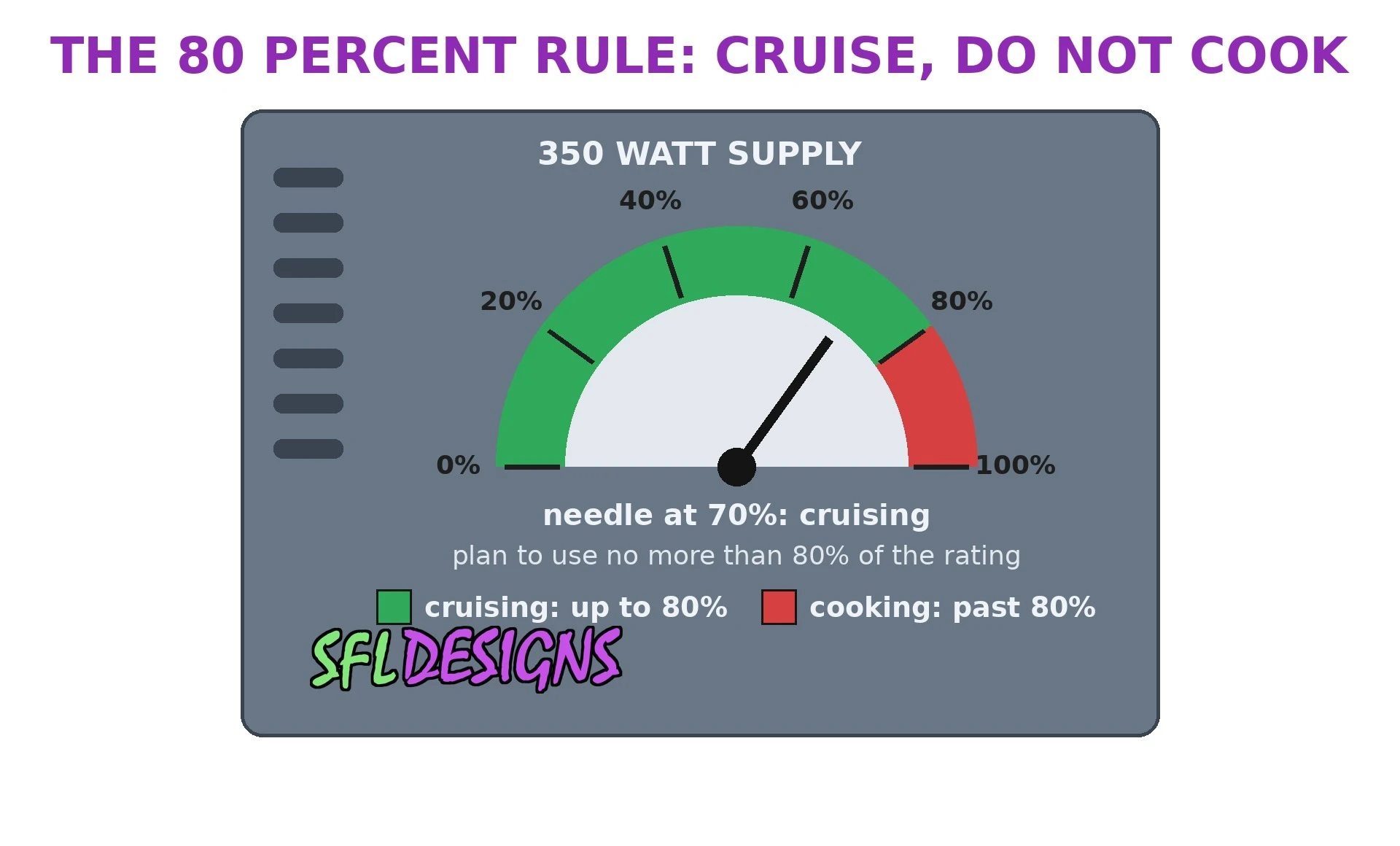
Here is the rule this whole post exists for: plan to use no more than 80 percent of what the supply says it can do.
A 350 watt supply is a 280 watt plan. Our 216 watt prop fits with room to spare. A supply run flat out at its rating works hard every minute: it runs hot, its fan runs loud, its parts age fast, and the first cold snap or extra prop can push it into shutting down to protect itself, usually mid-show, usually during the one song the neighborhood kids requested.
A supply cruising at 70 or 80 percent barely notices the same evening. Same show, same lights, completely different stress level. You are not buying watts you will never use. You are buying a supply that coasts through its tenth December the way it coasted through its first.
Why the name on the box matters
Buy a genuine Mean Well, from a real dealer, and here is why that is not brand snobbery.
A power supply is a promise: this box will hand out what the label says, all night, without getting dangerous about it. Mean Well has built its name on keeping that promise. The ratings are honest, the safety approvals are real, and the protection circuits (the parts that shut the supply down cleanly instead of letting it fail hot) actually work. The no-name bargain supply often cannot say any of that. Its label number is a hope, its insides are a gamble, and when it quits it tends to quit in ways that take pixels, controllers, or your evening with it.
There are also counterfeits wearing the Mean Well name, which is why the dealer matters as much as the brand. Buy from a supplier you can name, keep the receipt, and let somebody else be the bargain supply success story. In ten years of December nights, the cheap supply is the expensive one. Ask me how I know.
Before you check out
Count the pixels in each zone, run the math, and write the numbers down. Buy the genuine supply that covers the total at 80 percent, with the next prop you are already dreaming about counted in. Then this afternoon we do the most satisfying test in the whole series: we run bars across the whole house and find out whether the layout we built has been telling us the truth.
— Jason, SFL Designs
From our workbench to your display — print it, mount it, light it up.