
Groups: The Cheat Code Behind Whole-House Effects
Posted by SFL Designs on Nov 7th 2026
This morning we fed the far end of the run. Tonight we do the opposite kind of magic: instead of feeding every prop separately, we teach the whole house to answer to one name.
That name is a group, and groups are the closest thing xLights has to a cheat code.
What a group actually is
A group is a named list of models. That is all it is. It is not a prop, it does not plug into anything, and it holds no lights of its own. It is a list, like a playlist is a list of songs.
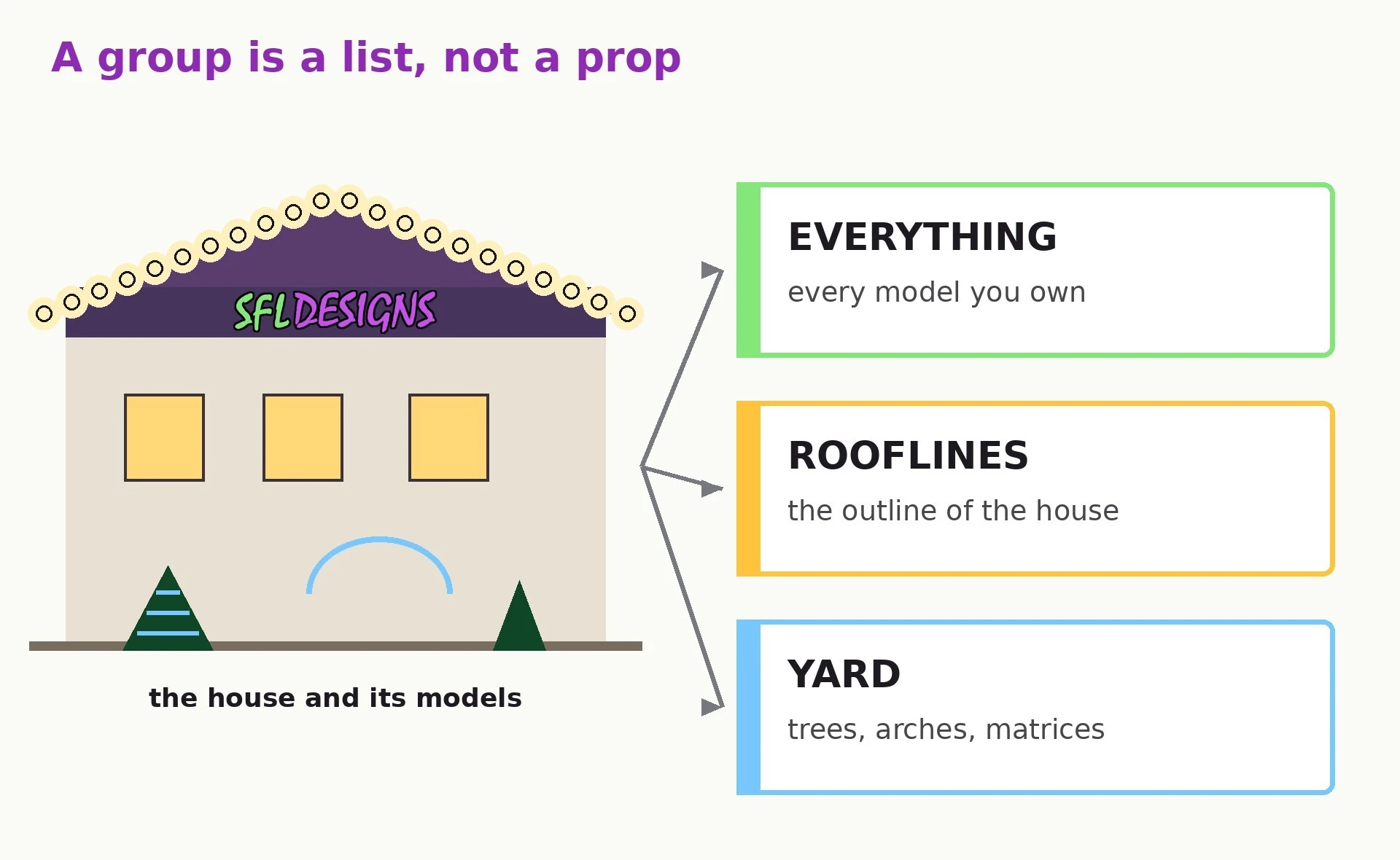
Your models are already built (we drew them back in October). A group just gathers the ones you want to treat as a unit. The rooflines can be a group. The yard props can be a group. Every model you own can sit in one big group called Everything.
Two facts make groups powerful. First, a model can belong to as many groups as you want. Your mega tree can live in Everything, in Yard, and in a group of just the tall things, all at once, and nothing about the tree itself changes. Second, groups are cheap. Making one costs a minute, so make the ones you might use and delete the ones you never touch.
Building one is simple in shape, whatever the current buttons are called: you make a new group, give it a name a tired human understands, and add the models that belong in it. Name groups the way you name controllers, for what they paint, not for what they are. "Rooflines" will make sense at midnight. "Group 7 Final" will not.
One effect, every prop
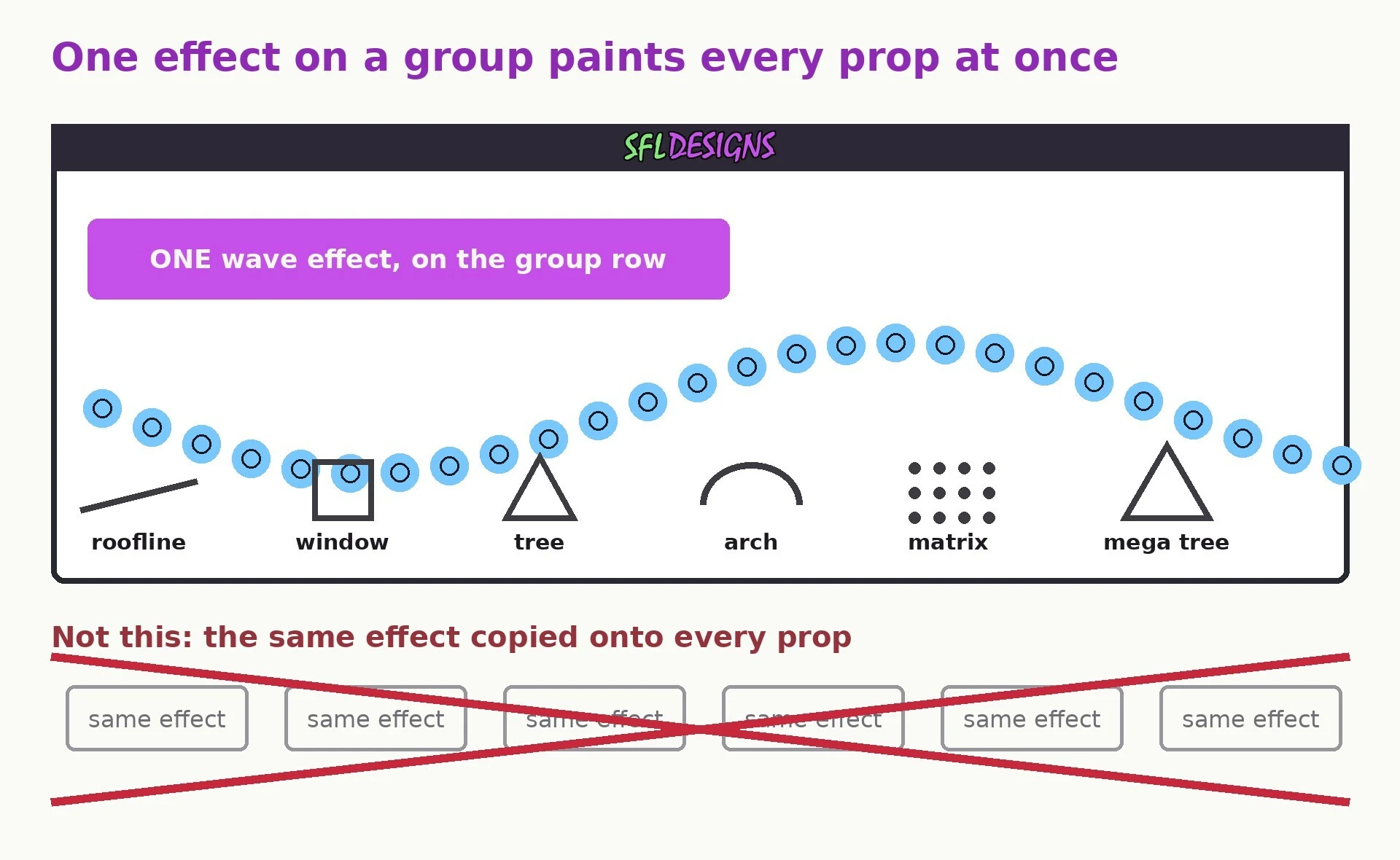
Here is the cheat. When you place an effect on a model, that model performs it. When you place an effect on a group, every model in the group performs it, together, from the one block you placed.
Without groups, a whole-house color wash means copying the same effect onto every prop, then fixing it twelve times when you change your mind about the color. With a group, it is one block on one row. Change the color once and the whole house changes its mind with you.
There is a subtlety worth knowing in plain words: an effect on a group can paint two ways. It can stretch across the whole group like one big canvas, so a wave rolls from the roofline down through the yard in one motion. Or it can repeat on each model separately, so every prop does the same move at the same time. Both are useful. The canvas version is the one that makes neighbors slow their cars down.
The groups worth building first
Start with three and you cover most of a show.
- Everything. Every model you own. This is the whole-house wash, the big finish, the all-on moment.
- Rooflines. The outline of the house itself. Roofline effects read as the skeleton of the show from the street.
- Yard. The props on the ground: trees, arches, matrices, the works. Yard effects move at street level, where the kids stand.
Groups run the bars test in pieces
Remember last Saturday afternoon and the bars test, where we swept bars across the whole house to catch a model lying about its direction or starting corner? The whole-house run tells you a lie exists. It does not always tell you where the liar lives.
Groups fix that too. Put the bars effect on one group at a time. Rooflines sweep clean. Yard sweeps clean. Faces sweep sideways. Congratulations, your liar lives in the Faces group, and your search just shrank from the whole house to a handful of props. A test you can aim is a test you will actually run, and this is the version worth running every time you change the layout.
Shop note: A model is not in any group until you put it there, and xLights will not remind you. Add a prop in November, forget the group step, and your whole-house wash will have one dark prop standing in the middle of it like a missing tooth. When a prop sits out a group effect, check its group membership before you check anything else. It is almost always the membership.
Where this leaves your layout
Your layout now has models, a controller that knows them, a power plan from this morning, and groups that let you paint the house in handfuls or all at once. That is a real show skeleton.
Next Saturday morning we open the controller box and meet its outposts, the receiver boards that let one brain run props clear across the yard. And next Saturday afternoon, those groups get their first song: your first sequence, timing tracks and all.
— Jason, SFL Designs
From our workbench to your display — print it, mount it, light it up.